
2025: The Year the Bitcoin Halving Cycle Died

For more than a decade, Bitcoin investors have anchored their expectations to cycles – a familiar, comforting, predictable rhythm of boom, bust, and recovery.
· the four-year halving.
· the US election calendar and
· a more subtle annual cycle.
Previous frameworks, such as Plan B’s Stock-to-Flow (S2F), which revolved heavily around the impact of the (approximately) four-year halving, weren’t perfect. Yet, they provided a structured framework for an asset that was young, volatile, and largely disconnected from the global financial system.
Then came 2025.
Bitcoin didn’t deliver the euphoric blow-off many were expecting.
But it hasn’t collapsed either.
Instead, it did something more disruptive.
It behaved like a mature macro asset.
This article explains why 2025 didn’t fail — it was the moment Bitcoin outgrew cycle-based thinking altogether, and the frameworks we can use to understand Bitcoin’s future trajectory.
Now we can see that it’s not the halving that drives Bitcoin’s price. Bitcoin doesn’t operate in a vacuum.
Rather than the halving cycle, other factors, such as liquidity and the business cycle, appear to be driving Bitcoin's price swings.
Why Bitcoin Cycles Worked — Until They Didn’t
Cycles exist because economic forces repeat. Supply shocks matter—liquidity ebbs and flows. Policy regimes rotate.
The problem is not that Bitcoin cycles were imaginary. The problem is that they were proxies for deeper forces — and by 2025, those forces ceased to respect the calendar.
However, narratives and stories, such as the four-year cycle, can still become self-fulfilling prophecies if enough people believe in them.
Stop Asking “Where Are We in the Cycle?”
While all models have their limitations, one that has stood the test of time (so far) is the power law, which is just a log-log plot of Bitcoin’s growth over time.
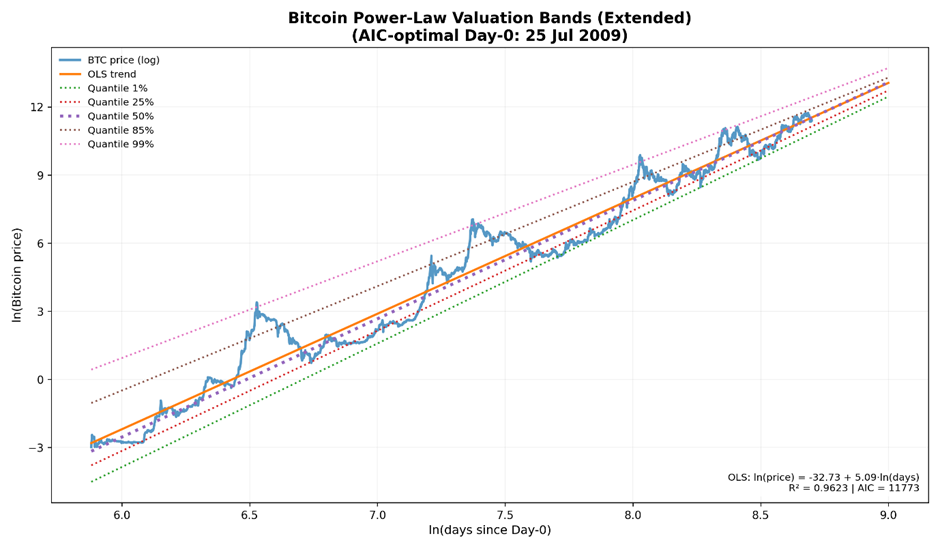
We can then transform this into an oscillator (which equals 0 when the price is at the 50th percentile and 1 when it’s at the 99th percentile) to understand the cycles around the power-law trend.
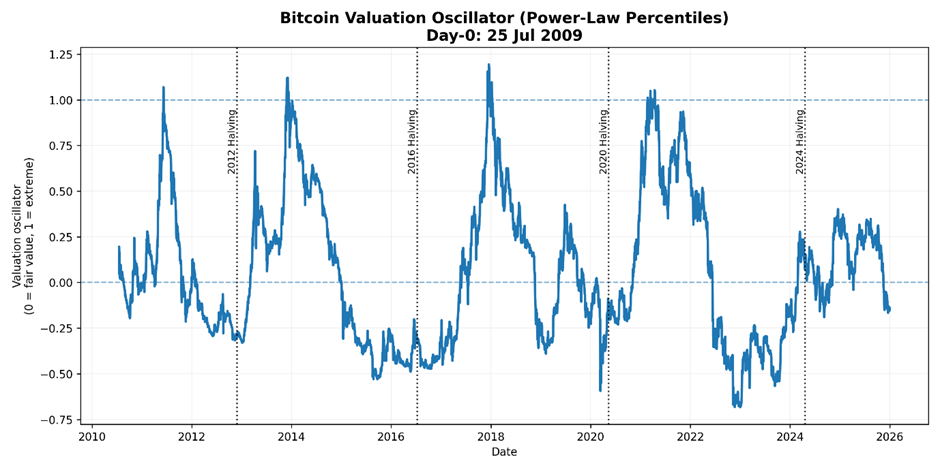
These cycles appeared to follow a predictable pattern that coincided with the halvings. However, over the past couple of years, the Bitcoin price has remained much closer to the power-law trend, without the massive pump-and-dump that many were expecting.
Seasonality Exists — But it’s Subtle
As we tick over into 2026, it’s a good time to review Bitcoin’s annual cycle.
When we overlay all the annual oscillations around the power-law trend, we observe a global trend, but there’s also a lot of noise.
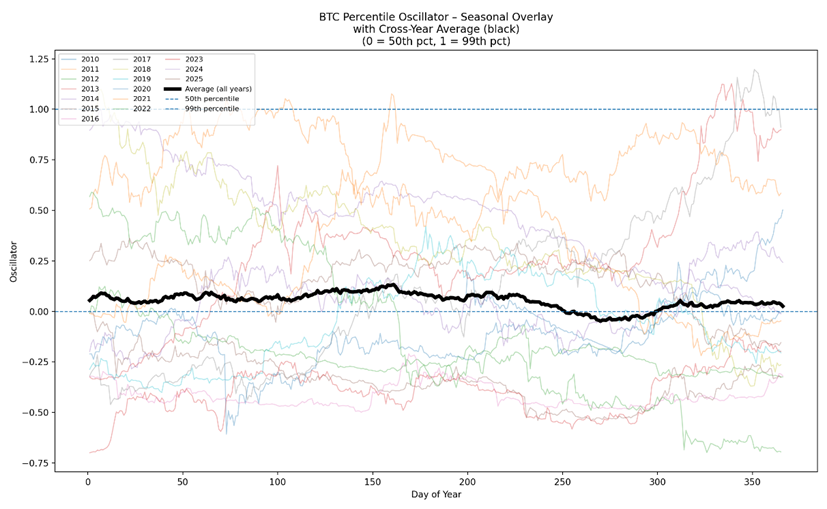
Based on the annual cycle, we might expect a slight increase when traders return in the new year and perhaps a peak in May as investors de-risk before the US summer holidays, but the signal is subtle in the global context.
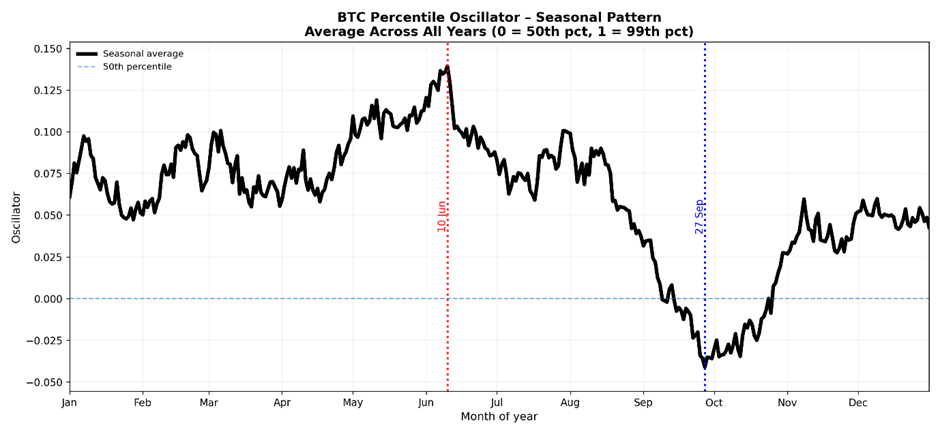
These annual patterns are likely to continue, but the signal is relatively small in the overall context.
The Halving Still Matters — It Just Doesn’t Lead Anymore
Historically, Bitociners believed that the Bitcoin halving produced a genuine supply shock. Last cycle, Plan B’s Stock-to-Flow model was super popular, but it seems to be broken now. Right now, it’s predicting BTC should be $376k.
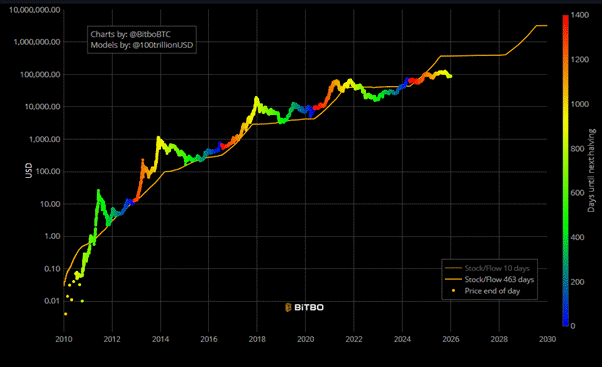
The impact of the halving appears to have diminished now that 95% of the Bitcoin that will ever exist has already been minted.
One explanation for the recent price action is that, rather than pumping to euphoric highs in October, Bitcoin appears to have front-run the traditional halving cycle, with many long-term holders derisking before the traditional peak. The current doldrums in Bitcoin's price may, in part, be a self-fulfilling prophecy driven by believers in the halving cycle selling off before the expected peak.
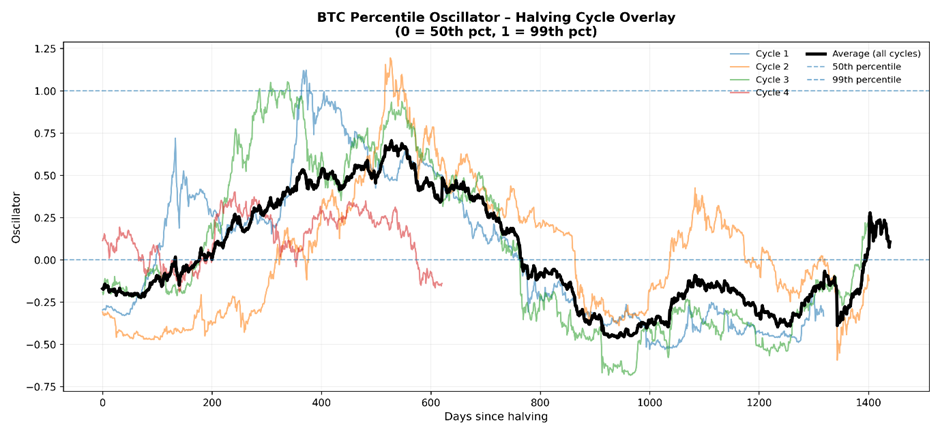
But the good news is that, without the leverage-driven pump, we’re unlikely to see as big a dump or as long and as deep a bear market, especially if the macro factors don’t also align with the cycle.
Elections Shape Sentiment, Not Bitcoin’s Trajectory
In the past, the halving and election cycle were largely aligned with the new government's release of new expenditure into the market, which also flowed into bitcoin. The U.S. election cycle can influence sentiment and capital flows.
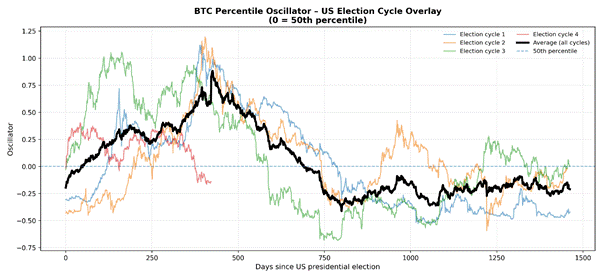
As shown in the chart above (red line), Bitcoin surged after the most recent election, with many expecting the new Trump administration to establish a Strategic Bitcoin Reserve and begin buying large quantities of Bitcoin.
Although we technically got the SBR, it included only previously seized bitcoin, with no new substantial purchases on the horizon.

There has also been considerable discussion about lowering interest rates to enable the government to roll over its debt, but so far, this remains talk. No one is quite sure whether the new Federal Reserve chair will be able to cut rates enough to boost the economy and Bitcoin, so there is still considerable caution around risk assets.
The Only Cycles That Matter Now: Liquidity and Macro Momentum
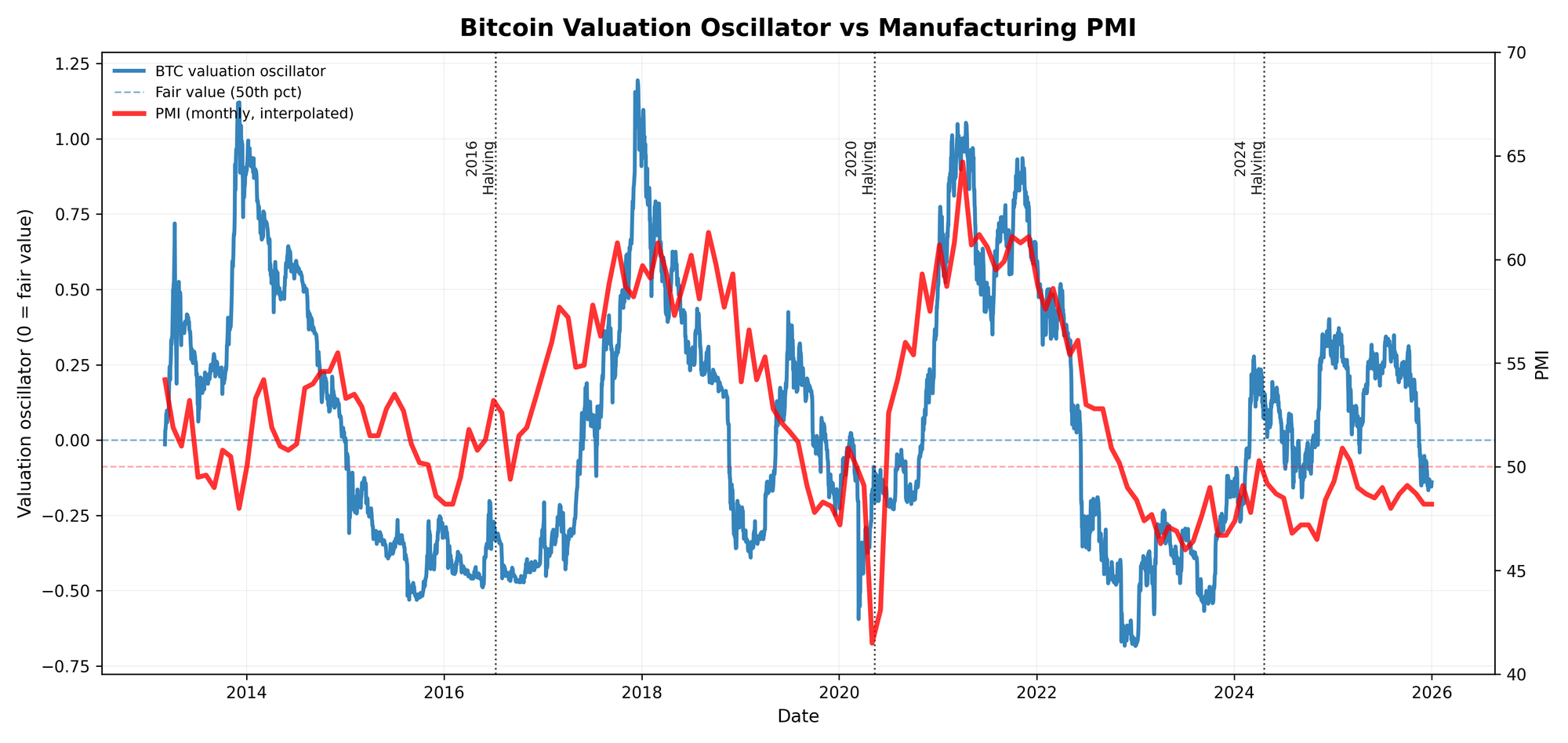
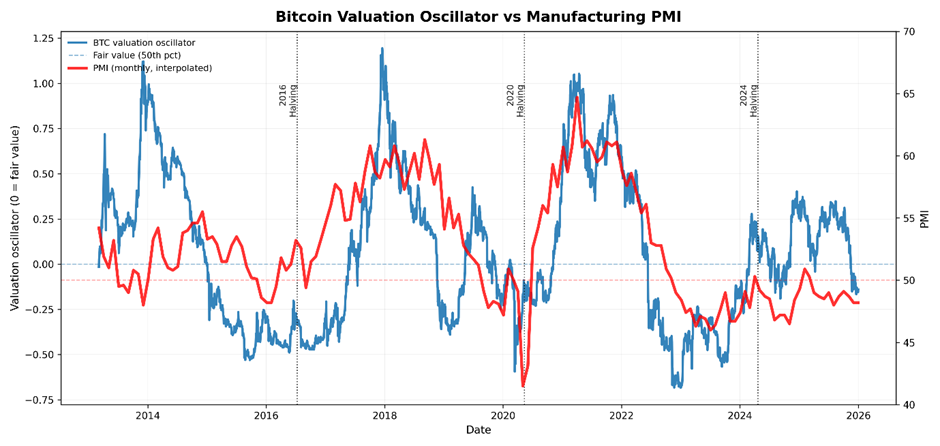
Over the past year, many Bitcoiners have realised that Bitcoin doesn’t operate in a vacuum independent of the macroeconomic context. When liquidity is tight, investors de-risk, but when money is cheap and flowing easily, bitcoin rips.
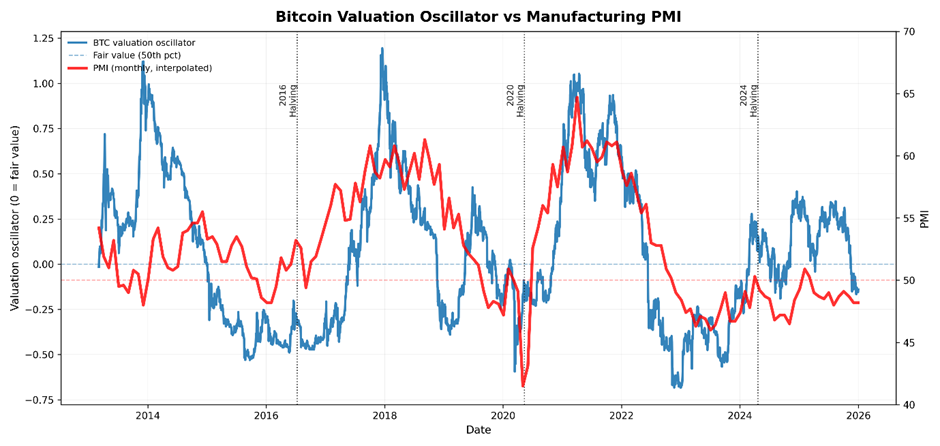
The ISM PMI appears to be the best gauge of this liquidity, aligning with previous peaks in Bitcoin. Unfortunately, the PMI has been depressed since early 2023, following the post-COVID stimulus and the collapse of the FTX bubble. Governments have been trying to act responsibly, using QT to put the liquidity genie back in the bottle.
As shown in the chart below, the ISM PMI closely aligns with Bitcoin’s oscillations around the power-law trend. Without a pump in the business cycle, Bitcoin has failed to achieve the blow-off top that the cycle believers were expecting.
What Drives Bitcoin Now?
The fact that Bitcoin is now a more stable asset that moves with the broader macroeconomic environment should be good news in the long run. The big money doesn’t want to hold a highly volatile asset that pumps and dumps every few years.
While it’s clear that Bitcoin does not follow a predetermined cycle, it does move in line with other factors. We’ve found the strongest correlation when we consider:
· hash rate (network strength),
· M2 (liquidity),
· the S&P 500,
· gold (the debasement trade), and
· IWM (small-cap, riskier stocks).
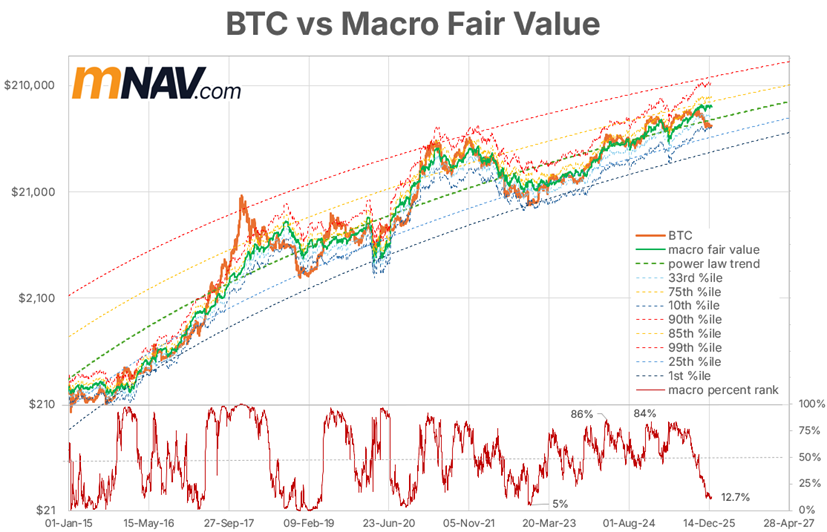
The good news for Bitcoin investors right now is that the price is lagging well below the current macro fair value. Possible reasons for this include:
· investors chasing AI, gold, and silver, which have been outperforming,
· Bitcoin’s consolidation in time after a massive post-election run-up, and
· the headwinds of four-year cycle sellers taking profits now, there is adequate liquidity, and the regulatory environment is easing.
Unfortunately, our models won’t tell you when Bitcoin will make its next move. However, they provide an indication of the fair value range based on historical trends.
|
|
Power law |
Macro fair value |
|
1st
%ile |
$50k |
$58k |
|
25th
%ile |
$69k |
$100k |
|
trend |
$100k |
$133k |
|
85th
%ile |
$148k |
$190k |
|
99th
%ile |
$254k |
$615k |
If you believe in Bitcoin over the long term, now is not the time to sell. In fact, it appears to be a low-risk entry point for those who still have dry powder (NFA).
Possible catalysts include:
· after investors finish their 2025 tax loss harvesting,
· if Trump gets his way and interest rates continue to decline into 2026,
· if gold, silver, and AI come off the boil and investors rotate into higher risk plays like Bitcoin,
· if the transition from Quantitative Tightening to Quantitative Easing accelerates, or
· as more states and sovereigns (like the UAE) start to see the value of Bitcoin as a reserve asset that can protect them from the inevitable inflation.
The New Question Investors Must Ask
Whatever the drivers, calendar-based cycles have lost explanatory power as Bitcoin matured. The cycles of the past may have been a mirage that gave us a false sense of security.
While Bitcoin may be less predictable in the future, the premise remains unchanged.
Without rigid cycles, no model can tell you exactly when Bitcoin will move.
But better models can tell you where you are.
The key question after 2025 is no longer: “Is this a bull or bear cycle?”
It is: “Is macro momentum improving — and is Bitcoin cheap or expensive relative to other correlated assets?”
Calendar-based cycles offered comfort.
Macro-based frameworks offer clarity.
Bitcoin may be less predictable going forward — but its long-term thesis remains intact.