
When Was Bitcoin Really Born? Separating Genesis Day from Economic Reality

Today marks 17 years since Bitcoin’s Genesis Block was mined on 3 January 2009.
Most people celebrate this date as Bitcoin’s birthday. And in a literal, technical sense, that’s correct. It was the moment the Bitcoin protocol came into existence.
But from an economic and modelling perspective, Genesis Day was more like Bitcoin’s conception than birth.
As you’ll see in this article, Bitcoin did not begin trading, forming a price, or acting as a store of value until a few months later. For the first several months, Bitcoin was an idea — a science project released into the world with no market, no liquidity, and no real price discovery.
That distinction may sound like semantics. But when you are trying to model Bitcoin’s long-term behaviour, it turns out to be critically important, especially for accurate modelling of where Bitcoin should be right now and where it’s going in the future.
Not only does optimising Bitcoin’s Day 0 improve the fit in the early days, but it also makes a big difference to current trend price predictions!
Genesis marks Bitcoin’s technological creation — but Bitcoin’s economic growth, and therefore its correct modelling origin, began months later.
Genesis Created Bitcoin — But Not a Market
On 3 January 2009, Satoshi Nakamoto mined the Genesis Block, embedding the now-famous headline: “Chancellor on the brink of second bailout for banks”.
This message anchored Bitcoin to the Global Financial Crisis and clarified the motivation for its creation.

But from an economic perspective, no market process had yet begun. There was:
· no market price discovery,
· no exchange,
· no capital at risk,
· no liquidity, and
· only one participant.
Bitcoin existed as software, not yet as an economic asset.
Why Time Anchoring Matters More Than Most Bitcoin Modelers Admit
Most Bitcoin modelers simplistically assume that time starts on Genesis Day.
That assumption is convenient. It’s clean. Everyone agrees on the date.
But convenience is not the same thing as correctness.
In growth modelling — whether for technologies, populations, or networks — the choice of time origin (Day-0) matters.
This is not about maximising fit for its own sake, but about identifying the correct starting point of the economic process being modelled.
The charts below present log-log regressions with quantile projections for Bitcoin’s price and market cap, with the standard Genesis Date used as Day 0. Notice how the quantile bands intersect and fan out when time is anchored to Genesis.
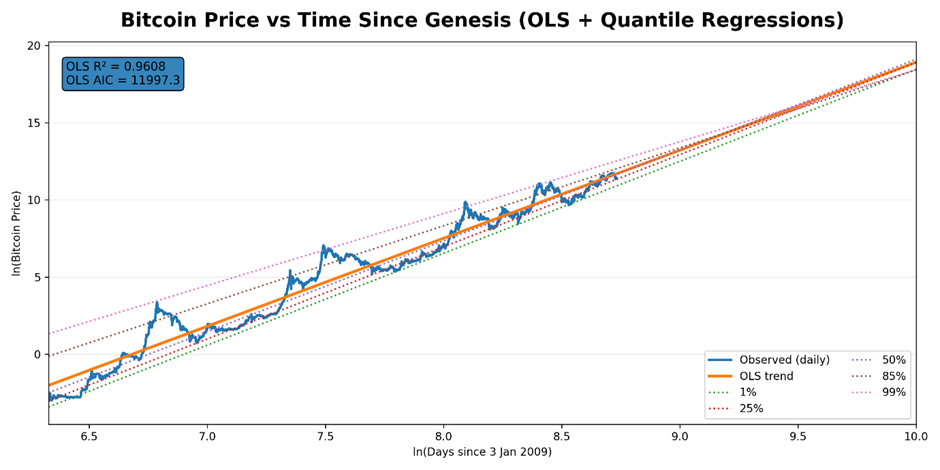
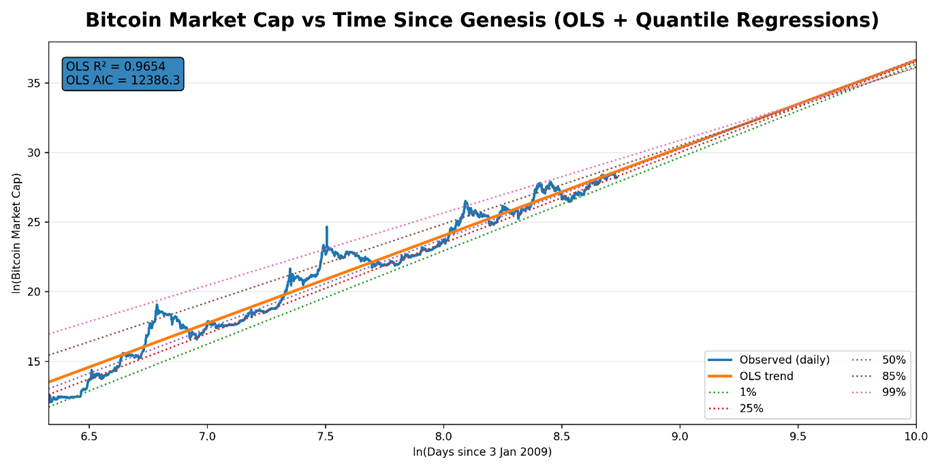
If we’re using the power law to project Bitcoin’s future growth, we really want these projections to be as clean as possible.
When Bitcoin Started Behaving Like an Asset
Bitcoin’s first sustained trading, pricing, and capital formation emerged months after Genesis, as:
· early exchanges appeared,
· participants began assigning value,
· and Bitcoin transitioned from an experiment into a monetary network.
Bitcoin Pizza wasn’t until 22 May 2010 (the first time someone exchanged bitcoin for something in the real world), and the first reliable exchange-based data is not available until 17 July 2010!
If you were interested in understanding when Bitcoin's price discovery started or when Bitcoin started acting as a store of value, you could argue that either of these dates was more logical than when the first block was mined.
Logically, any period between 3 January 2009 and 15 July 2010 is eligible as Day 0 for accurate power-law modelling.
Rather than assuming a Day 0 for modelling, we can optimise the regression to determine the optimal Day 0.
Finding Bitcoin’s Economic Birthday in the Data
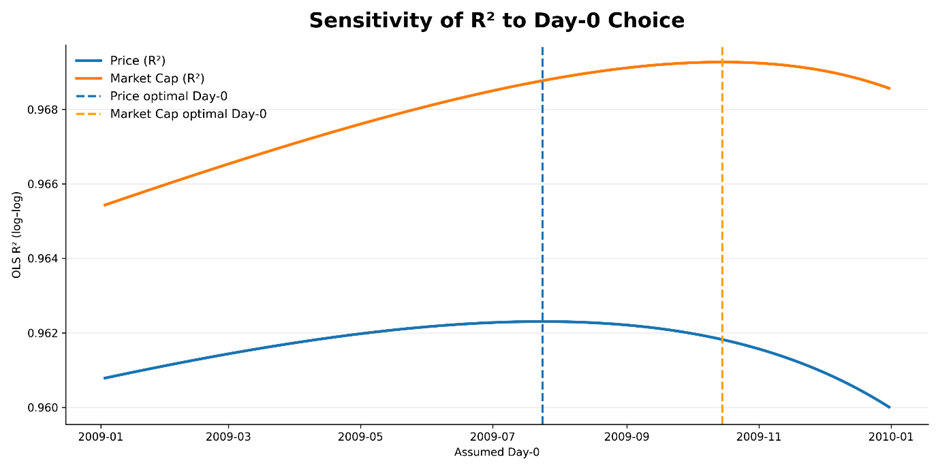
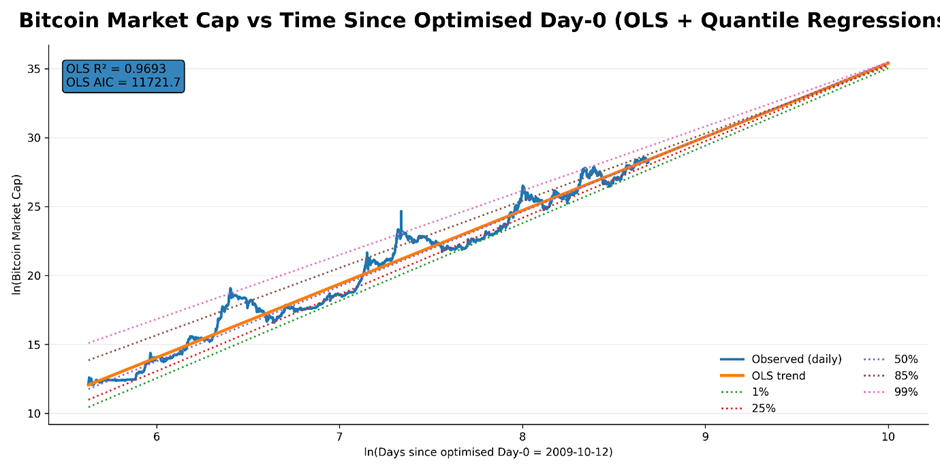
We can optimise Day-0 to find the time origin that best linearises Bitcoin’s long-run log–log behaviour. As shown in the chart below, the optimal Day 0 for the price data is 24 July 2009, while for the market cap data, it’s 12 October 2009.
The Evolution of Day 0
If we analyse the data incrementally, optimal Day-0 initially fluctuates between Genesis Day and Pizza Day before stabilising.
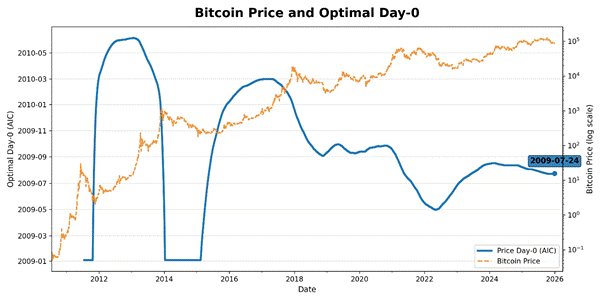
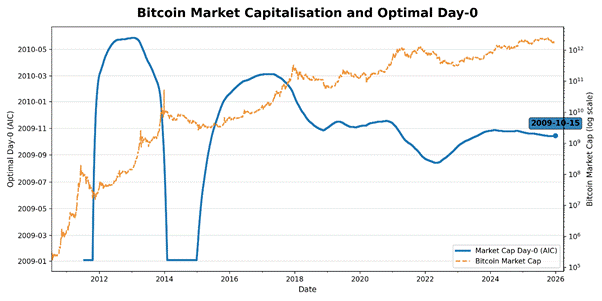
While some might call this curve fitting, it’s really diagnosing the correct origin of the economic process.
Why the Optimised Day-0 Produces Better Models
When we re-anchor time to Bitcoin’s economic birth, several improvements emerge immediately:
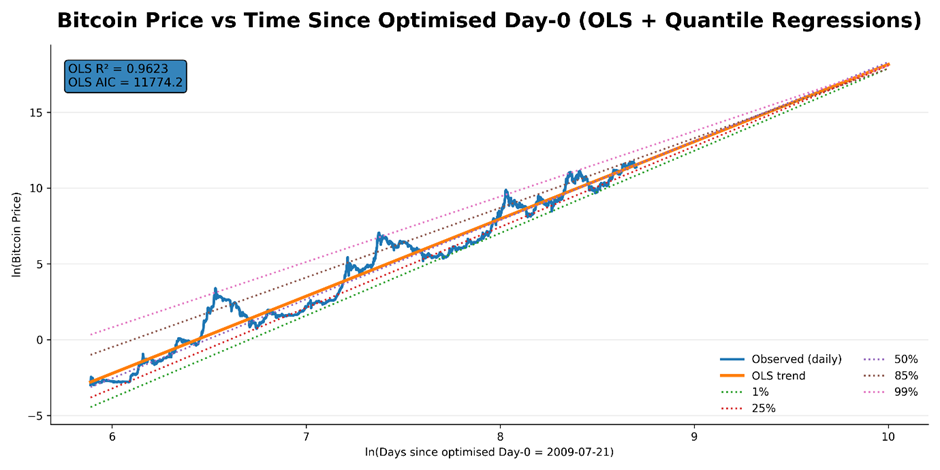
· Tighter Quantile Bands - Price and market cap oscillate cleanly within stable quantile envelopes.
· Parallel Long-Term Growth - Upper and lower quantiles remain approximately parallel, indicating a structurally consistent growth process.
· Reduced Early-Time Distortion - The model no longer has to “bend” to accommodate the noise in the early market data.
· Better Forward Behaviour - Extensions to long horizons remain well-behaved and interpretable.
With the optimised Day-0, the quantile regressions become much cleaner with no overleaps for decades to come.
Re-interpreting Bitcoin’s Current Trend Price
Perhaps the most relevant point of this regression optimisation is the impact on the current forecast price of Bitcoin.
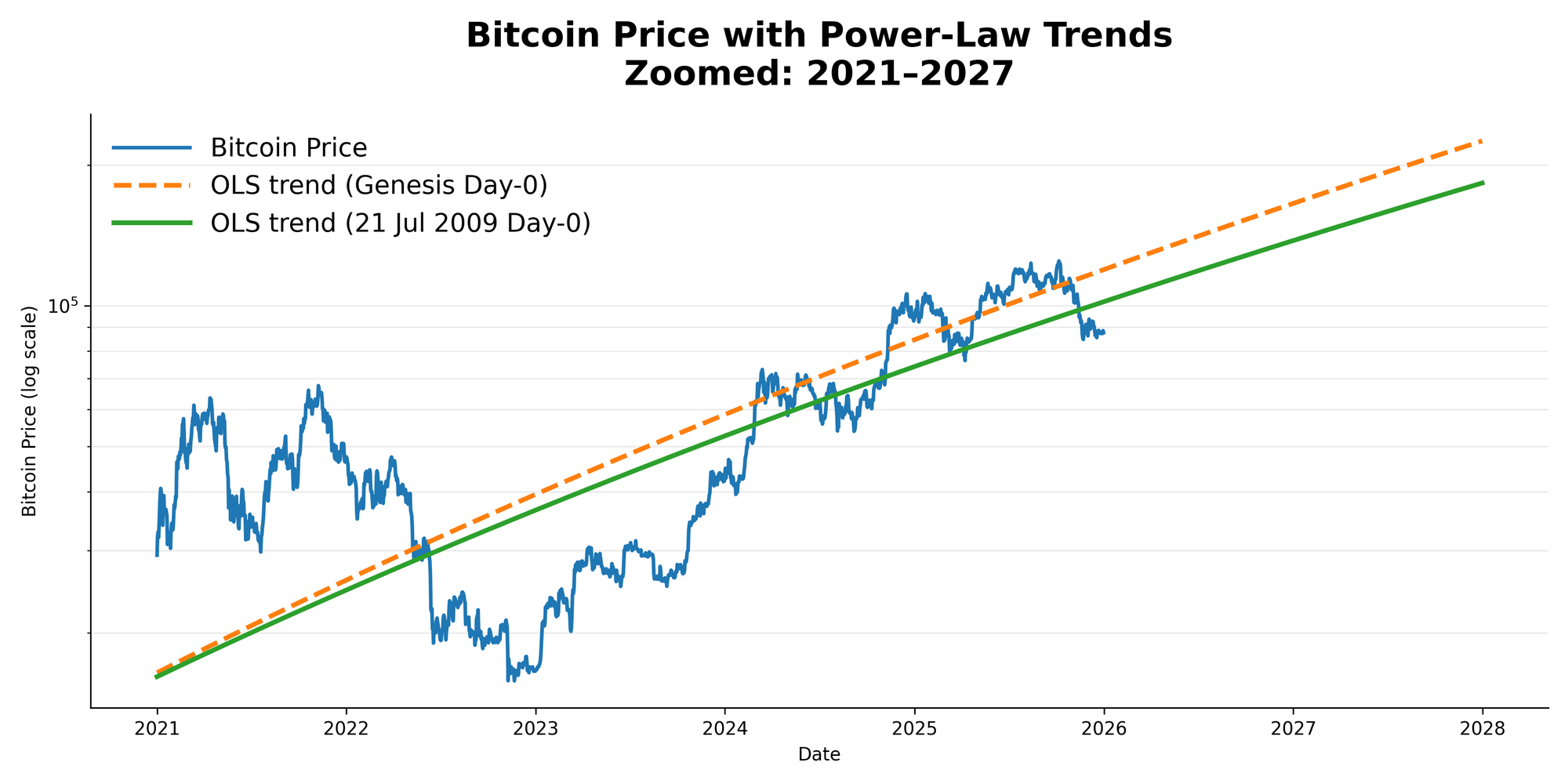
When we examine the long-term trends, we observe that the optimised power-law trend (green line) fits the early data better. The optimised Day 0 regression is more conservative and better aligns with recent price action.
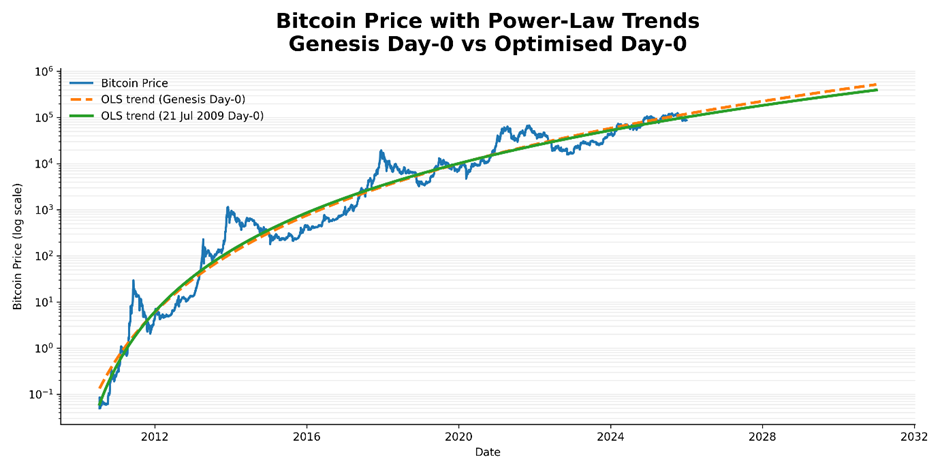
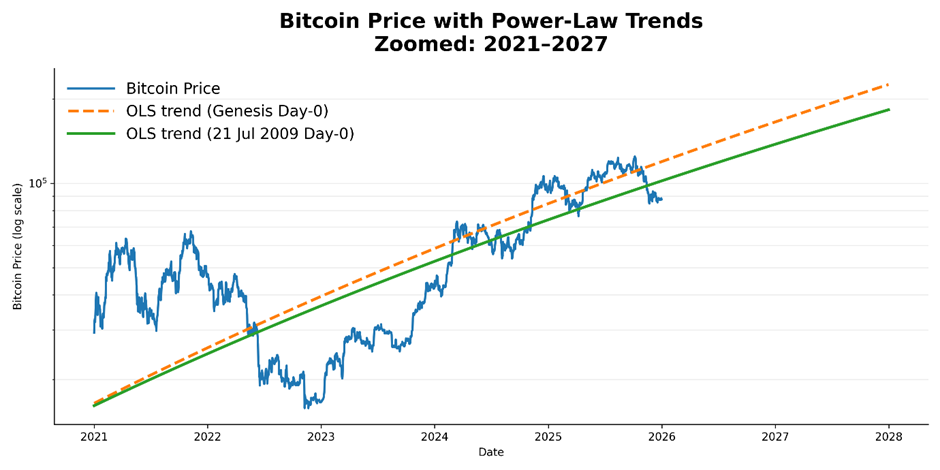
When we zoom in, we see that the Genesis Day trend has a current price of $119k, whereas the optimised day 0 trend has a more conservative price of $102k. At the end of 2028, this gap widens to $302k for the Genesis Day power-law regression and $240k for the optimised day-0 trend.
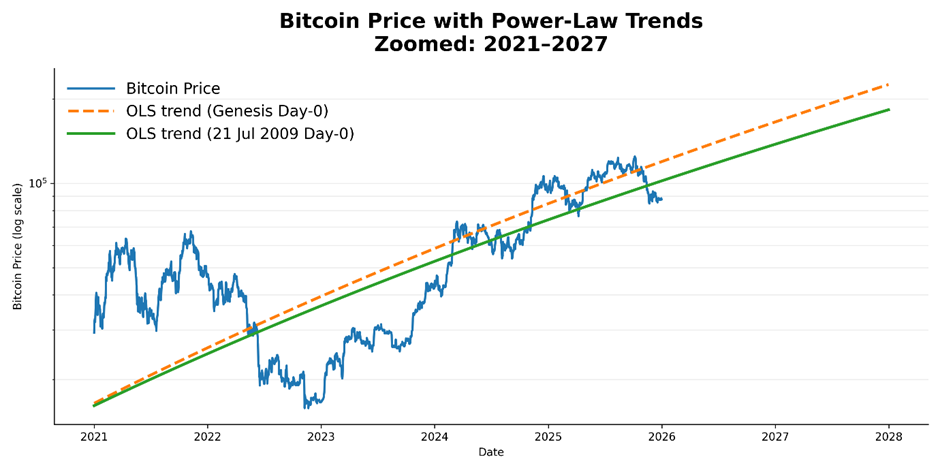
While not so good for fueling overly bullish, overly optimistic expectations, it’s more realistic and safer. When we use the Optimal Day 0, Bitcoin doesn't appear to be in a massive bear market; it's on track.
This Isn’t Rewriting History — It’s Modelling It Correctly
Using an optimised Day-0 does not deny the importance of Genesis:
· Genesis remains Bitcoin’s technological origin, just like 31 October 2008 remains Bitcoin’s conceptual origin.
· It remains symbolically and historically foundational.
· It remains the moment digital scarcity was launched.
· But economic modelling requires economic time.
Just as we don’t model Amazon’s revenue from the day it was incorporated, we shouldn’t model Bitcoin’s market behaviour from the day its first block was mined.
In summary:
• Genesis = technological birth
• July–Oct 2009 = economic birth
• Optimised Day-0 → cleaner models and more conservative, safer projections